Themes
Military strategy and revolutionary war
1928–1949 · From guerrilla to mobile war, from defence to offence — the conception of war, strategic initiative, and the dialectic of 'protraction'.
Background
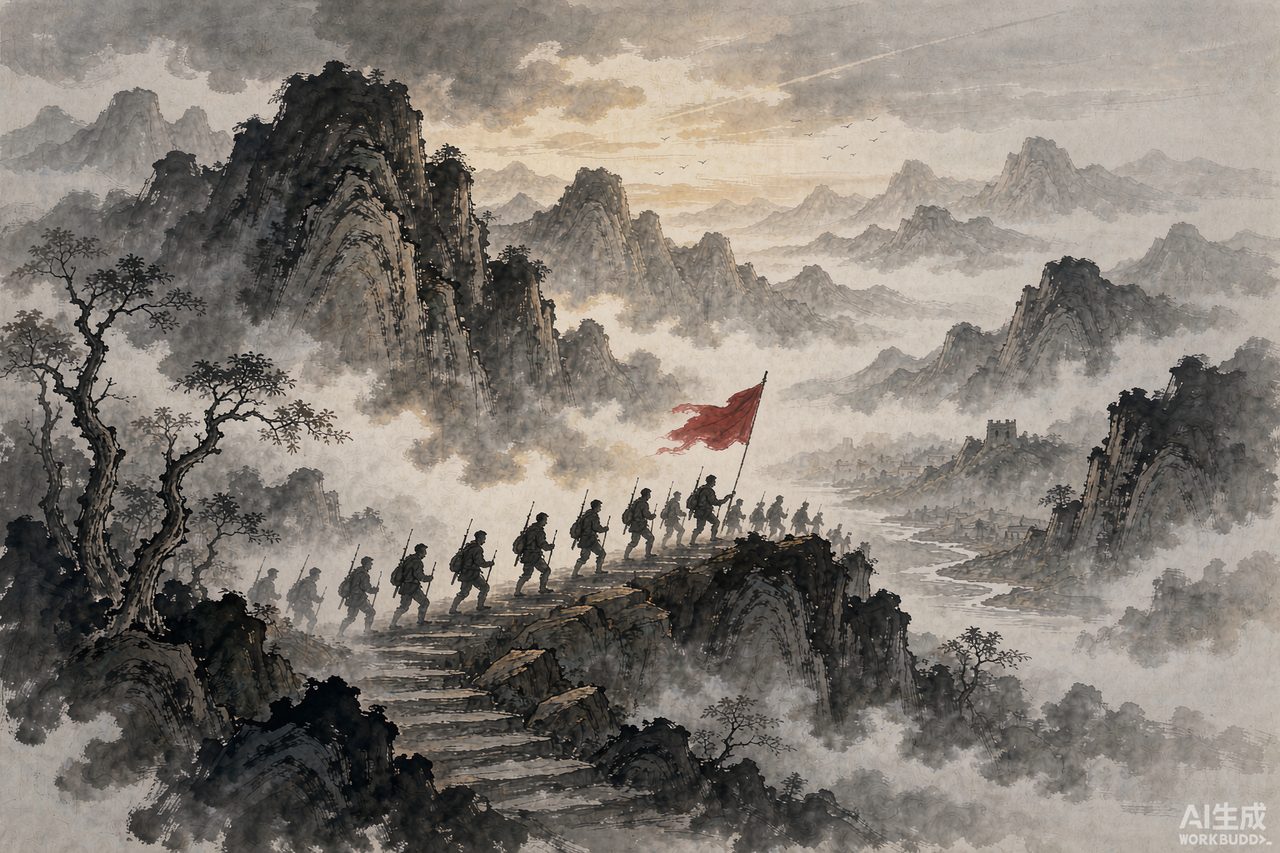
The heaviest and most influential body of writing in the Selected Works of Mao Zedong concerns war and strategy. These texts came out of the concrete practice of the Communist–Kuomintang civil wars and the War of Resistance against Japan, and their central concern is a single question: in a long-term situation where the enemy is strong and we are weak, how can an armed force rooted in the countryside and drawn mainly from the peasantry, through correct strategy, progressively reverse the balance of forces and win in the end? The methodology is not abstract deduction but is drawn from concrete campaigns — the Chingkang Mountains, the counter-'encirclement and suppression' campaigns of the Central Soviet Area, the guerrilla war behind enemy lines, the War of Liberation. The thesis of 'protracted war' was advanced to answer the most urgent question of its day: can the war be won, and how? 'Concentrate a superior force to destroy the enemy forces one by one' is the operational principle for turning an overall weakness into local superiority in individual campaigns. Throughout, this discourse keeps military affairs inside a political frame: strategy itself is subordinate to the larger question of who unites whom and for whom one fights. The theme is therefore both a technical summation of fighting and the material foundation for understanding the political judgements of the whole collection — without the perspective of war, one cannot grasp how the Chinese revolution of the twentieth century moved from remote mountains to nationwide power. Along the timeline, the argument evolves clearly: in the Agrarian Revolutionary War period it argues for 'armed independent regimes of workers and peasants' and 'encircling the cities from the countryside'; in the War of Resistance it shifts to 'protracted war' and the strategic place of guerrilla war behind enemy lines; in the War of Liberation it is systematized as the 'ten major principles of operation' and the strategic decisive battles. Each turn corresponds to an actual change in the balance of forces, not to a theory evolving on its own. This pragmatic disposition — changing as the relative strength of the two sides changes — is what distinguishes it from doctrinaire military theory, and it is why later researchers cite it again and again. As for specific essays, Problems of Strategy in China's Revolutionary War answers the lessons of the failure of the fifth counter-'encirclement' campaign, insisting above all on recognizing the necessity of strategic retreat; Problems of War and Strategy starts from the judgement that 'political power grows out of the barrel of a gun' and fixes armed struggle at the centre of the revolution. The Present Situation and Our Tasks marks the shift from defence to offence, the ten major principles being its codification; the command telegrams for the Liaoning–Shenyang, Peiping–Tientsin and Huai-hai campaigns show how theory was translated into concrete dispositions for decisive battle. It should be noted that this military discourse never ascribes victory to courage or morale alone; it repeatedly stresses that subjective direction must accord with objective conditions. This is what sets it apart from mere agitation and entitles it to be read as material in the study of strategy.
Excerpts from the text
Many people are talking about a protracted war, but why is it a protracted war? How to carry on a protracted war?
— On Protracted War
The method of fighting by concentrating a superior force to destroy the enemy forces one by one must be employed not only in the disposition of troops for a campaign but also in the disposition of troops for a battle.
— Concentrate a Superior Force to Destroy the Enemy Forces One by One
It signifies still more progress and development in a commander who is capable of exercising command in a war at its lower stages, if he becomes capable of exercising command in its higher stages.
— Problems of Strategy in China's Revolutionary War
Modern relevance
The modern significance of this theme lies not in any specific battle method but in its strategic thinking of 'seeking truth from facts': honestly acknowledge the reality of the balance of forces first, then look for the levers that can change that balance in time and space. Breaking a total objective into executable stages and seeking local initiative at every stage has referential value for any long-term undertaking that must win against stronger opposition. Readers should treat it as a historical document about strategic patience and initiative, not as an operations manual; the word 'protracted' embodies a sober estimate of the factor of time — a military statement of the old lesson that haste defeats itself. What deserves attention today is its reliance on information and judgement: nearly every strategic conclusion is premised on a concrete inventory of both sides' strength, terrain and morale. This habit of deciding on evidence rather than slogans is a methodological legacy more transferable than any single battle method — it reminds everyone facing long competition that advantage can be created through correct arrangements of space and time. Another notable feature is the discourse's insistence on 'initiative': advantage is never treated as a static given but as something dynamic to be won by dispositions of troops, choice of battlefield and grasp of timing. Such consciousness of initiative has meaning for any actor on the defensive who refuses a passive fate. Connected with it is the balance between the twin aims of 'preserving oneself and destroying the enemy' — neither rushing to battle nor avoiding battle to survive, but finding the most favourable point of intersection between the two. Trading stages for initiative and accumulating the local into the whole is the true strategic meaning of the word 'protracted'.
From guerrilla to mobile war, from defence to offence — the conception of war, strategic initiative, and the dialectic of 'protraction'.